
💡 Ready to create amazing music? Download your Suno creations in high quality →
Suno AI Prompts Guide: Master Music Creation with Perfect Prompts (2026)
Creating great music with Suno AI starts with one crucial element: the prompt. Whether you're a beginner struggling to get decent results or an experienced user looking to refine your technique, mastering the art of writing effective Suno AI prompts is the key to unlocking professional-quality music.
In this comprehensive guide, you'll discover:
- How Suno AI interprets your prompts
- The anatomy of a perfect prompt
- 50+ ready-to-use prompt templates across genres
- Advanced techniques used by power users
- Common mistakes and how to avoid them
- Real examples and case studies
Understanding How Suno AI Processes Prompts
Before diving into prompt creation, it's essential to understand how Suno AI interprets your instructions.
The AI's Decision-Making Process
When you input a prompt, Suno's AI analyzes several layers:
- Genre Recognition: Identifies musical style characteristics
- Mood Analysis: Determines emotional tone and energy level
- Instrumentation: Selects appropriate instruments and sounds
- Structure Planning: Organizes song sections (verse, chorus, bridge)
- Vocal Style: Chooses vocal characteristics and delivery
- Production Elements: Adds effects, reverb, and mixing touches
What the AI Understands Best
Suno AI responds particularly well to:
- Specific genre names (e.g., "synth-pop" vs. "electronic")
- Emotional descriptors (e.g., "melancholic," "uplifting," "aggressive")
- Tempo indicators (BPM or descriptive terms like "fast," "mid-tempo")
- Instrument mentions (e.g., "acoustic guitar," "analog synths")
- Era references (e.g., "80s," "90s hip-hop," "modern trap")
- Production style (e.g., "lo-fi," "polished," "raw," "cinematic")
Anatomy of a Perfect Suno AI Prompt
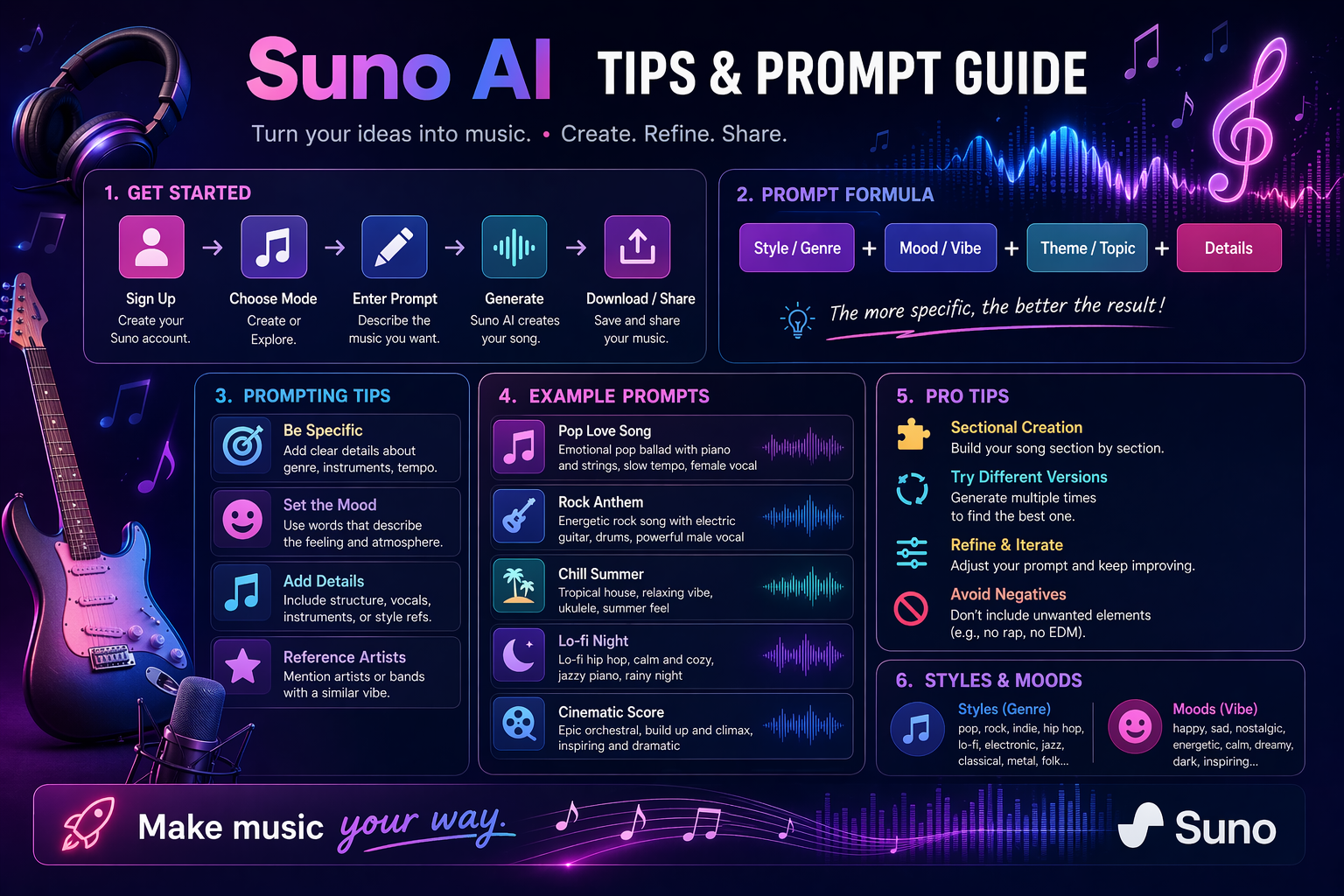
A well-structured prompt contains multiple elements working together. Let's break down the components:
Basic Prompt Structure
[Genre] + [Mood/Emotion] + [Topic/Theme] + [Vocal Style] + [Instrumentation] + [Tempo/Energy]Example Breakdown
Basic Prompt:
"Create a pop song about love"
Advanced Prompt:
"Create an upbeat synth-pop song at 128 BPM about summer romance, featuring female vocals with dreamy reverb, prominent bassline, and catchy synth hooks. Style inspired by 80s new wave with modern production. Structure: verse-chorus-verse-chorus-bridge-chorus."
Why the advanced prompt works better:
| Element | Basic | Advanced | Impact |
|---|---|---|---|
| Genre | "pop" | "synth-pop" | More specific sound |
| Mood | None | "upbeat" | Clear emotional direction |
| Tempo | None | "128 BPM" | Precise energy level |
| Topic | "love" | "summer romance" | Vivid imagery |
| Vocals | None | "female vocals with dreamy reverb" | Specific vocal character |
| Instruments | None | "prominent bassline, catchy synth hooks" | Clear instrumentation |
| Era/Style | None | "80s new wave with modern production" | Production aesthetic |
| Structure | None | Detailed structure | Professional song format |
50+ Suno AI Prompt Templates by Genre
Here's a comprehensive collection of prompt templates you can use immediately. Customize these templates by swapping out specific elements to match your vision.
Pop Music Prompts
-
Upbeat Pop
"Create an energetic pop song at 120-130 BPM about overcoming challenges, featuring powerful female vocals, bright synths, punchy drums, and an anthemic chorus. Modern production with radio-friendly polish."
-
Dreamy Pop
"Generate a dreamy indie pop track at 90-100 BPM about nostalgia and memories, with ethereal female vocals, reverb-drenched guitars, atmospheric synths, and laid-back beats. Shoegaze influences."
-
Dance Pop
"Produce a dance-pop banger at 125-135 BPM about living in the moment, featuring upbeat male vocals, four-on-the-floor kick, energetic synth drops, and club-ready production."
-
Acoustic Pop
"Create an intimate acoustic pop song at 80-90 BPM about personal growth, with warm male vocals, fingerpicked acoustic guitar, subtle strings, and organic percussion. Unplugged aesthetic."
-
Electropop
"Generate an electropop track at 115-125 BPM about digital love and connection, featuring robotic vocal effects, glitchy production, pulsing bass, and futuristic sound design."
Rock Music Prompts
-
Alternative Rock
"Create an alternative rock song at 140-150 BPM about rebellion and freedom, with gritty male vocals, distorted electric guitars, driving bass, and explosive drums. 90s grunge influences."
-
Indie Rock
"Produce an indie rock track at 110-120 BPM about small-town life, featuring earnest vocals, jangly guitars, melodic basslines, and dynamic drumming. Lo-fi production aesthetic."
-
Hard Rock
"Generate a hard rock anthem at 130-140 BPM about standing your ground, with aggressive vocals, heavy guitar riffs, thunderous drums, and arena-ready chorus. Modern metal production."
-
Classic Rock
"Create a classic rock song at 100-110 BPM about the open road, featuring bluesy male vocals, guitar solos, organ pads, and steady rock groove. 70s rock production style."
-
Pop Punk
"Produce a pop punk track at 160-180 BPM about teenage angst and friendship, with energetic vocals, power chords, fast drums, and catchy melodies. Early 2000s punk revival sound."
Electronic Music Prompts
-
House Music
"Create a deep house track at 120-125 BPM with smooth vocal chops, warm basslines, jazzy chord progressions, and hypnotic grooves. Underground club vibe."
-
Trance
"Generate an uplifting trance anthem at 135-140 BPM with ethereal female vocals, soaring synth leads, emotional breakdowns, and powerful drops. Festival-ready production."
-
Dubstep
"Produce a dubstep banger at 140 BPM (half-time) with aggressive bass drops, wobbly sub-bass, metallic sound design, and intense builds. Modern brostep influences."
-
Drum & Bass
"Create a liquid drum & bass track at 170-175 BPM with soulful vocals, atmospheric pads, intricate breakbeats, and deep sub-bass. Smooth and melodic approach."
-
Techno
"Generate a driving techno track at 130-135 BPM with minimal vocals, industrial percussion, dark atmospheres, and relentless energy. Underground warehouse vibe."
Hip-Hop & R&B Prompts
-
Trap
"Create a trap banger at 130-150 BPM (half-time) about success and hustle, featuring confident rap vocals, 808 bass, hi-hat rolls, dark synths, and hard-hitting drums."
-
Old School Hip-Hop
"Produce an old school hip-hop track at 90-100 BPM about lyrical skill and authenticity, with boom-bap drums, sampled soul loops, scratching, and conscious rap vocals. 90s golden era sound."
-
Contemporary R&B
"Generate a smooth R&B song at 70-80 BPM about late-night conversations, featuring silky male vocals, warm Rhodes keys, subtle 808s, and atmospheric production. Modern alternative R&B style."
-
Lo-Fi Hip-Hop
"Create a lo-fi hip-hop beat at 75-85 BPM with mellow piano samples, vinyl crackle, laid-back drums, and jazzy guitar loops. Perfect for studying and relaxation."
-
Afrobeats
"Produce an afrobeats track at 100-110 BPM with infectious rhythms, melodic vocals, log drums, shakers, and vibrant percussion. Modern Afro-fusion production."
Cinematic & Ambient Prompts
-
Epic Cinematic
"Create an epic cinematic orchestral piece at 80-90 BPM with powerful brass, soaring strings, thunderous percussion, and dramatic dynamics. Hollywood trailer music style."
-
Ambient Soundscape
"Generate an ambient soundscape at 60-70 BPM with evolving textures, ethereal pads, field recordings, and meditative atmospheres. Perfect for meditation and focus."
-
Film Score
"Produce a film score cue at 100-110 BPM for an emotional scene, featuring solo piano, swelling strings, subtle electronics, and cinematic tension. Contemporary film music."
-
Video Game Music
"Create an adventurous video game soundtrack at 120-130 BPM with orchestral elements, electronic percussion, memorable melodies, and dynamic layering. RPG exploration theme."
-
Dark Ambient
"Generate a dark ambient track at 50-60 BPM with ominous drones, industrial textures, distant echoes, and unsettling atmospheres. Horror film soundtrack aesthetic."
Country & Folk Prompts
-
Modern Country
"Create a modern country song at 90-100 BPM about hometown roots, featuring heartfelt male vocals, acoustic guitar, pedal steel, fiddle, and steady country rhythm. Nashville production."
-
Folk Ballad
"Produce a traditional folk ballad at 70-80 BPM telling a story of love and loss, with intimate vocals, fingerpicked guitar, mandolin, and minimal arrangement. Acoustic authenticity."
-
Bluegrass
"Generate an upbeat bluegrass track at 140-160 BPM with fast banjo, fiddle harmonies, tight vocal harmonies, and acoustic energy. Traditional Appalachian sound."
-
Country Rock
"Create a country rock anthem at 110-120 BPM about living free, with gritty vocals, electric guitar licks, driving rhythm section, and southern rock attitude."
-
Indie Folk
"Produce an indie folk song at 85-95 BPM with introspective lyrics, layered vocal harmonies, acoustic instrumentation, and organic production. Bon Iver meets Fleet Foxes."
Jazz & Blues Prompts
-
Smooth Jazz
"Create a smooth jazz instrumental at 90-100 BPM with saxophone melodies, Fender Rhodes, upright bass, and subtle drums. Late-night lounge atmosphere."
-
Jazz Fusion
"Generate a jazz fusion track at 110-120 BPM with complex chord progressions, virtuosic solos, syncopated rhythms, and electric instrumentation. 70s fusion influences."
-
Blues Rock
"Produce a blues rock song at 80-90 BPM with soulful vocals, expressive guitar bends, walking bass, and shuffle drums. Classic Chicago blues meets rock energy."
-
Bebop Jazz
"Create a bebop jazz instrumental at 180-200 BPM with fast tempos, intricate melodies, improvisational sections, and acoustic trio setup. Charlie Parker era authenticity."
-
Neo-Soul
"Generate a neo-soul track at 85-95 BPM with smooth vocals, jazzy chord extensions, live instrumentation, and hip-hop influenced drums. Erykah Badu meets D'Angelo."
Experimental & Genre-Bending Prompts
-
Synthwave
"Create a synthwave track at 100-110 BPM with retro 80s synths, gated reverb drums, neon-soaked atmospheres, and nostalgic melodies. Drive soundtrack aesthetic."
-
Future Bass
"Produce a future bass anthem at 150-160 BPM (half-time) with supersaw chords, pitched vocal chops, emotional drops, and colorful sound design. Festival main stage energy."
-
Chillwave
"Generate a chillwave track at 85-95 BPM with washed-out synths, hazy vocals, summer nostalgia, and lo-fi production. Bedroom pop meets 80s synth-pop."
-
Industrial
"Create an industrial track at 120-130 BPM with metallic percussion, distorted vocals, mechanical rhythms, and dark atmospheres. Nine Inch Nails influences."
-
Psychedelic
"Produce a psychedelic rock track at 70-80 BPM with trippy guitar effects, reversed audio, sitar textures, and mind-bending production. 60s psychedelic revival."
Seasonal & Thematic Prompts
-
Summer Anthem
"Create an ultimate summer anthem at 125-130 BPM about beach parties and good vibes, featuring upbeat vocals, tropical synths, steel drums, and infectious energy."
-
Winter Ballad
"Generate a winter ballad at 70-80 BPM about longing and cold nights, with emotional vocals, piano melodies, string arrangements, and intimate production."
-
Workout Motivation
"Produce a high-energy workout track at 140-150 BPM with aggressive vocals, pounding drums, motivational lyrics, and intense drops. Gym motivation music."
-
Romantic Dinner
"Create a romantic dinner soundtrack at 65-75 BPM with smooth jazz guitar, soft piano, subtle strings, and intimate atmospheres. Candlelight ambiance."
-
Road Trip
"Generate a road trip anthem at 110-120 BPM about adventure and freedom, with anthemic vocals, driving guitars, steady rhythms, and sing-along choruses."
Advanced Combination Prompts
-
Genre Fusion: Classical + Trap
"Create a genre-bending track at 140 BPM combining classical orchestra (strings, brass, woodwinds) with modern trap beats (808s, hi-hats, snares). Epic meets urban."
-
Genre Fusion: Jazz + Electronic
"Produce an electro-jazz fusion at 115-125 BPM with live saxophone, jazz piano samples, glitchy electronic production, and broken beat rhythms."
-
Genre Fusion: Metal + Synthwave
"Generate a metal-synthwave hybrid at 140 BPM with heavy guitar riffs, retro synths, aggressive vocals, and neon-soaked production. Cyberpunk aesthetic."
-
Mood Transition
"Create a song that starts melancholic (minor key, sparse arrangement, soft vocals) and builds to triumphant (major key, full instrumentation, powerful vocals). Emotional journey."
-
Dynamic Structure
"Produce a track with distinct sections: ambient intro (0:00-0:30), building verse (0:30-1:00), explosive chorus (1:00-1:30), stripped bridge (1:30-2:00), final climax (2:00-2:30). Cinematic arc."
Advanced Prompt Engineering Techniques
Once you've mastered the basics, these advanced techniques will take your Suno AI prompts to the next level.
1. Reference Track Descriptions
Instead of just naming a genre, describe specific sonic characteristics:
Basic:
"Create a pop song"
Advanced:
"Create a pop song with crisp, punchy drums similar to Max Martin productions, layered vocal harmonies in the chorus, bright major key synths, and a bassline that drives the rhythm. Polished radio production with wide stereo imaging."
2. Emotional Arc Specification
Guide the AI through emotional transitions:
"Start with intimate, vulnerable verses featuring minimal piano and whispered vocals. Build to an explosive, cathartic chorus with full band, powerful vocals, and soaring strings. Create a sense of overcoming struggle and finding strength."
3. Production Technique Keywords
Include specific production terminology:
- Mixing terms: "sidechain compression," "parallel compression," "wide stereo field"
- Effects: "tape saturation," "vinyl emulation," "analog warmth"
- Spatial: "intimate close-mic'd vocals," "large hall reverb," "dry and upfront"
- Dynamic: "heavy compression for punch," "dynamic range for emotion"
Example:
"Create a track with warm analog tape saturation, parallel compression on drums for punch, wide stereo synths, and intimate close-mic'd vocals with subtle plate reverb."
4. Instrumentation Layering
Specify multiple layers for richness:
"Layer multiple synth textures: warm analog bass synth, bright plucky lead synth, atmospheric pad in the background, and arpeggiated high-end synth. Each layer should occupy its own frequency space."
5. Vocal Production Details
Go beyond just "male" or "female" vocals:
- Tone: "breathy," "raspy," "smooth," "powerful," "delicate"
- Processing: "heavy Auto-Tune," "natural pitch correction," "distorted vocals," "doubled vocals"
- Style: "belting," "falsetto," "whispered," "rapped," "sung-spoken"
- Effects: "large hall reverb," "delay throws," "vocal chops," "harmonies"
Example:
"Feature breathy female vocals with subtle pitch correction, doubled in the chorus for thickness, with delay throws on key phrases and lush three-part harmonies in the bridge."
6. Cultural and Regional Specificity
Add cultural context for authenticity:
"Create a Latin pop track at 95 BPM with authentic reggaeton dembow rhythm, Spanish guitar flourishes, urban trap-influenced drums, and passionate Spanish vocals. Modern Bad Bunny meets classic Ricky Martin production."
7. Era-Specific Production
Dial in specific decades:
80s Production:
"Use gated reverb on snare, analog synth bass (Roland Juno-106 style), bright FM electric piano (Yamaha DX7), and chorus-effect guitars. 1985 production aesthetic."
90s Production:
"Feature boom-bap drum samples, filtered disco loops, gritty MPC swing, and sampled soul vocals. 1994 hip-hop golden era sound."
2000s Production:
"Include crunk-style 808s, snap tracks, synth brass stabs, and heavy compression. Mid-2000s hip-hop production."
8. Negative Prompting (What to Avoid)
Sometimes it's helpful to specify what you don't want:
"Create a minimal techno track with hypnotic grooves and subtle evolution. Avoid: aggressive drops, obvious melodies, vocal chops, or dramatic breakdowns. Keep it stripped and functional for DJ mixing."
Prompt Optimization Workflow
Follow this systematic approach to refine your prompts:
Step 1: Start with a Base Template
Choose a template from the collection above that matches your general vision.
Step 2: Generate Initial Version
Create your first generation without overthinking. This gives you a baseline.
Step 3: Critical Listening
Listen to the result and identify:
- ✅ What works well?
- ❌ What doesn't match your vision?
- 🔧 What specific elements need adjustment?
Step 4: Targeted Prompt Refinement
Based on your analysis, modify the prompt:
If the energy is wrong:
Add: "higher energy," "more aggressive," "increase tempo to [X] BPM"
If the instrumentation is off:
Add: "more prominent [instrument]," "reduce [instrument]," "replace [instrument] with [instrument]"
If the mood isn't right:
Add: "darker mood," "more uplifting," "add melancholy undertones"
If the production quality feels off:
Add: "more polished production," "lo-fi aesthetic," "professional mixing"
Step 5: Iterate Systematically
Repeat the generate-listen-refine cycle 3-5 times, making one or two changes per iteration to understand what each modification does.
Step 6: Document What Works
Keep a prompt journal:
Prompt Version 1: [Original prompt]
Result: [What worked, what didn't]

Prompt Version 2: [Modified prompt]
Changes made: [Specific modifications]
Result: [Improvement notes]

Final Version: [Best prompt]
Key learnings: [Insights for future prompts]
Common Prompt Mistakes and How to Fix Them
Avoid these common pitfalls that lead to disappointing results:
Mistake 1: Too Vague
Problem:
"Make a good song"
Fix:
"Create an upbeat indie pop song at 115 BPM about new beginnings, featuring bright electric guitars, energetic drums, optimistic male vocals, and an anthemic chorus. Modern festival-ready production."
Mistake 2: Contradictory Instructions
Problem:
"Create a calm, aggressive metal track with soft vocals and heavy distortion"
Fix:
Choose one direction: "Create an aggressive metal track at 150 BPM with screamed vocals, heavy guitar distortion, and intense drums" OR "Create a calm acoustic ballad at 70 BPM with soft male vocals, gentle fingerpicked guitar, and intimate production"
Mistake 3: Overloading the Prompt
Problem:
"Create a song with jazz drums, metal guitars, trap beats, classical strings, EDM drops, folk vocals, and ambient textures"
Fix:
Focus on 2-3 complementary elements: "Create a progressive metal track at 130 BPM with technical guitar riffs, complex drum patterns, and orchestral string arrangements. Modern progressive metal production with cinematic elements."
Mistake 4: Ignoring Tempo and Energy
Problem:
No tempo or energy level specified
Fix:
Always include BPM or energy descriptors: "Create a high-energy track at 140 BPM" or "Create a mid-tempo groove at 95 BPM"
Mistake 5: Forgetting About Structure
Problem:
No song structure guidance
Fix:
Specify desired structure: "Structure: intro-verse-chorus-verse-chorus-bridge-chorus-outro"
Mistake 6: Not Specifying Vocal Style
Problem:
Vocals don't match the vision
Fix:
Be specific about vocal characteristics: "Powerful female vocals with gospel influences" or "Whispered male vocals with heavy reverb"
Mistake 7: Using Obscure References
Problem:
"Make it sound like that one song from 2003"
Fix:
Use clear, descriptive language: "Create a track with early 2000s nu-metal production: downtuned guitars, DJ scratching, aggressive rap-rock vocals, and heavy compression"
Case Studies: From Bad to Great Prompts
Let's examine real transformations:
Case Study 1: Pop Song Evolution
Version 1 (Too Basic):
"Pop song about love"
Result: Generic, forgettable, lacks direction
Version 2 (Adding Specifics):
"Upbeat pop song about falling in love, 120 BPM, female vocals, synths"
Result: Better, but still generic
Version 3 (Fully Optimized):
"Create an upbeat synth-pop anthem at 124 BPM about the euphoria of new love. Feature breathy female vocals with layered harmonies, pulsing analog bassline, bright arpeggiated synths, and a massive earworm chorus. Add pre-chorus build-up with rising synth sweeps. Structure: verse-pre-chorus-chorus-verse-pre-chorus-chorus-bridge-chorus. Modern production with 80s synthwave influences."
Result: Professional, distinctive, radio-ready
Case Study 2: Electronic Track Refinement
Version 1:
"House music"
Result: Generic four-on-the-floor, uninspired
Version 2:
"Deep house track, 122 BPM, smooth vibes"
Result: Better mood, but still generic
Version 3:
"Create a deep house groove at 122 BPM with jazzy undertones. Feature warm Rhodes chord progressions, smooth saxophone samples, rolling bassline, crisp hi-hats with swing, and subtle vocal chops. Add atmospheric pads in the background. Build tension with filtered sweeps and drum rolls. Underground Chicago house aesthetic with modern production clarity. 6-minute arrangement for DJ mixing."
Result: Authentic, detailed, DJ-ready
Case Study 3: Rock Song Transformation
Version 1:
"Rock song"
Result: Generic rock, no character
Version 2:
"Alternative rock, fast, angry vocals"
Result: Better energy, but one-dimensional
Version 3:
"Create an alternative rock anthem at 145 BPM about breaking free from expectations. Feature gritty male vocals that transition from restrained verses to explosive choruses. Distorted electric guitars with alternative tunings, driving bass, dynamic drums with explosive fills. Add atmospheric guitar textures in the bridge. 90s grunge meets modern alternative rock production. Structure: quiet-loud dynamics throughout."
Result: Emotionally compelling, dynamic, memorable
Pro Tips from Power Users
Learn from experienced Suno AI users:
Tip 1: Build a Prompt Library
Save every successful prompt in an organized system:
- By genre
- By mood
- By instrumentation
- By use case (commercial, personal, experimental)
Tip 2: Study Music Theory Basics
Understanding basic music theory dramatically improves your prompts:
- Learn BPM ranges for different genres
- Understand major vs. minor key emotions
- Know common song structures
- Recognize production techniques
Tip 3: Use Reference Tracks Strategically
Listen to professional songs in your target genre and note:
- Tempo and energy level
- Instrumentation choices
- Production characteristics
- Song structure
- Vocal style and processing
Then describe these elements in your prompt.
Tip 4: Embrace Happy Accidents
Sometimes the AI produces unexpected but brilliant results. Don't always chase perfection—explore interesting deviations.
Tip 5: Combine Multiple Generations
For complex projects:
- Generate instrumental base
- Generate vocals separately
- Generate additional layers (pads, leads, percussion)
- Mix them together in a DAW
This gives you more control over the final product.
Tip 6: Pay Attention to Suno's Updates
Suno AI constantly evolves. What works today might work differently tomorrow. Stay updated with:
- Official Suno announcements
- Community forums
- Social media groups
- Prompt sharing communities
Tip 7: Test Prompt Variations Systematically
When you find a working prompt, test variations:
- Change BPM by ±5-10
- Swap instruments (piano → guitar)
- Modify vocal style (male → female)
- Adjust production descriptors (lo-fi → polished)
Document which changes have the biggest impact.
Frequently Asked Questions
Q1: How long should my Suno AI prompts be?
A: There's no strict limit, but the sweet spot is 50-200 words. Long enough to be specific, short enough to stay focused. Quality matters more than quantity—every word should serve a purpose.
Q2: Can I use artist names in my prompts?
A: Yes, but be strategic. Instead of "make a song like Taylor Swift," try "create a pop song with confessional lyrics, catchy melodies, and polished production inspired by mainstream pop artists." This avoids potential copyright issues while achieving similar results.
Q3: Why does the AI sometimes ignore parts of my prompt?
A: Suno AI prioritizes certain elements over others. Genre, mood, and tempo are usually respected. Very specific details (exact chord progressions, precise lyrics) may be interpreted loosely. Focus on high-level direction rather than micro-management.
Q4: Should I write lyrics in the prompt?
A: You can include lyric themes or specific phrases, but Suno works best when you describe the emotional content rather than writing full lyrics. Example: "lyrics about overcoming adversity with hopeful imagery" works better than pasting complete verses.
Q5: How do I get better vocals?
A: Be specific about:
- Vocal type (male/female/androgynous)
- Vocal style (breathy/powerful/whispered)
- Processing (natural/heavy Auto-Tune/reverb)
- Language and accent
- Harmony arrangements
Q6: Can I create instrumental-only tracks?
A: Yes! Simply specify "instrumental" in your prompt and avoid mentioning vocals. Example: "Create an instrumental cinematic orchestral piece with powerful brass and strings."
Q7: What if I keep getting similar results?
A: Try these strategies:
- Change the genre completely
- Adjust BPM significantly (±20)
- Add unexpected instrumentation
- Modify production descriptors
- Use more specific mood words
- Try different structural approaches
Q8: Do capital letters or punctuation matter?
A: Not significantly, but clear punctuation helps the AI parse your prompt. Use commas to separate ideas and periods to end complete thoughts. Avoid ALL CAPS (doesn't increase emphasis).
Q9: Can I create songs in different languages?
A: Yes! Specify the language in your prompt: "Create a Spanish-language flamenco-pop song at 100 BPM with passionate female vocals, acoustic guitar, and traditional Spanish percussion."
Q10: How many generations should I run?
A: Plan for 3-5 generations minimum. First generation explores direction, generations 2-3 refine, generations 4-5 polish. Some prompts nail it on the first try, but iteration is normal.
Advanced: Customizing Prompts for Specific Use Cases
Tailor your prompts based on where the music will be used:
For Content Creation (YouTube, TikTok, Podcasts)
"Create an upbeat, copyright-free background track at 110 BPM for video content. Feature positive vibes, non-distracting melodies, consistent energy, and loopable structure. No sudden drops or dramatic changes. Modern vlog music aesthetic."
Key considerations:
- Consistent energy (no dramatic dynamics)
- Non-intrusive melodies
- Loopable structure
- Clear mood for brand alignment
For Commercial Use (Ads, Presentations)
"Create a professional corporate track at 100 BPM with uplifting mood, clean production, and motivational energy. Feature piano melodies, subtle strings, and modern electronic elements. Background music for presentations and commercials."
Key considerations:
- Professional polish
- Uplifting but not overwhelming
- Clean, modern production
- Broad appeal
For Personal Listening
"Create a deeply personal indie folk song at 80 BPM about self-discovery and growth. Feature intimate male vocals, fingerpicked acoustic guitar, subtle strings, and honest emotional delivery. Bon Iver meets Iron & Wine."
Key considerations:
- Emotional authenticity
- Artistic expression
- Personal taste over mass appeal
- Experimental freedom
For Live Performance
"Create an energetic live performance track at 135 BPM with big choruses, crowd-ready moments, and dynamic builds. Feature anthemic vocals, powerful drums, and festival-ready production. Include breakdown section for audience interaction."
Key considerations:
- High energy
- Memorable hooks
- Dynamic moments for live interaction
- Powerful drops and builds
For Sync Licensing (TV, Film, Games)
"Create a cinematic underscore track at 90 BPM for dramatic scenes. Feature evolving textures, emotional string arrangements, subtle piano, and building tension. Leave space for dialogue. Professional film score production."
Key considerations:
- Leave frequency space for dialogue
- Emotional clarity
- Professional mixing
- Appropriate dynamics for scene support
Conclusion
Mastering Suno AI prompts is a journey of experimentation, iteration, and creative discovery. The key takeaways:
- Specificity wins: Detailed prompts produce better results than vague instructions
- Structure matters: Organize your prompts with clear sections and logical flow
- Genre knowledge helps: Understanding musical characteristics improves your descriptions
- Iteration is normal: Plan for multiple generations to refine your vision
- Document everything: Keep a prompt library of what works
- Stay flexible: Embrace happy accidents and unexpected directions
With over 50 prompt templates and advanced techniques at your disposal, you're now equipped to create professional-quality music across any genre. Remember, the best prompt is the one that helps you express your unique creative vision.
🎵 Ready to put these techniques into practice? Start creating with Suno AI and download your masterpieces in high quality →
Your next step: Choose one template from this guide, customize it to your vision, and generate your first track. Then iterate, refine, and watch your prompt engineering skills grow with each creation.
Happy music-making!
Related Resources:
- How to Download Suno Music: Complete Guide (MP3/WAV Formats)
- AI Song Creator: How to Create Music with AI in 2026
Disclaimer: This guide is for educational purposes. Always respect copyright laws and platform terms of service when creating and using AI-generated music.
