
AI Song Creator: How to Create Music with AI in 2026
Imagine composing a professional-quality song in minutes—even if you've never played an instrument or read a single note of music. That's the revolutionary power of AI song creators.
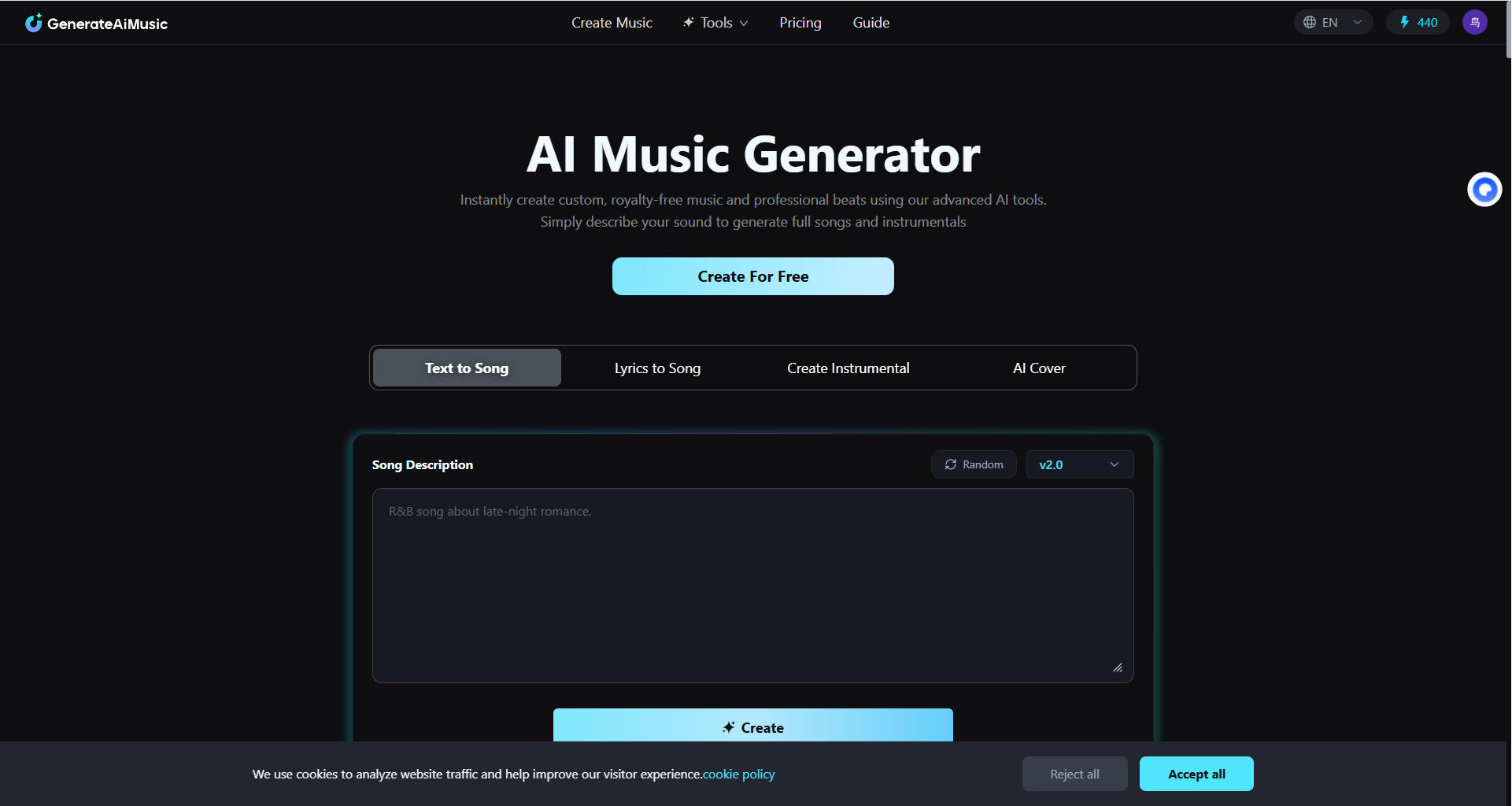
Visit https://generateaimusic.com/ for a comprehensive AI music creation experience.
The landscape of music creation has transformed dramatically. What once required expensive equipment, years of training, and a full production team can now be accomplished from your laptop with the right AI song creator. Whether you're a content creator needing background music, an aspiring artist exploring new creative avenues, or simply curious about the intersection of technology and art, AI music generation has opened doors that were closed just a few years ago.
In this comprehensive guide, you'll learn:
- How AI song creators actually work
- The top AI music tools available in 2026
- Step-by-step instructions to create your first AI song
- Advanced techniques for professional-quality results
- Legal considerations and best practices
- The future of AI in music production
What is an AI Song Creator?
An AI song creator is a software tool that uses artificial intelligence and machine learning to compose original music. These platforms analyze vast databases of existing music to understand patterns in melody, harmony, rhythm, and song structure. When you provide input—whether it's a text description, a few hummed notes, or specific parameters—the AI generates unique musical compositions based on what it has learned.
How AI Music Generation Works
The technology behind AI song creators typically involves:
- Deep Learning Models: Neural networks trained on millions of songs across genres and eras
- Pattern Recognition: Identifying musical patterns that make songs catchy and emotionally resonant
- Generative Algorithms: Creating new combinations of musical elements that sound pleasing
- Style Transfer: Adapting compositions to match specific genres or artist styles
This doesn't mean the AI is copying existing songs. Rather, it's like a musician who has studied thousands of compositions and internalized the principles of what makes music work—then creates something entirely new based on that foundation.
The Evolution of AI Music
AI music generation has evolved rapidly:
| Era | Technology | Capabilities |
|---|---|---|
| 2015-2018 | Basic rule-based systems | Simple melodies, limited styles |
| 2019-2021 | Early neural networks | Multi-instrument compositions, basic genre adaptation |
| 2022-2024 | Advanced deep learning | Vocals, lyrics, complex arrangements |
| 2025-2026 | Multimodal AI | Full song production, real-time collaboration, style cloning |
Today's AI song creators like SongAI represent the cutting edge of this technology, capable of producing radio-quality tracks that rival human compositions.
Top AI Song Creator Platforms in 2026
The AI music landscape is crowded with options. Here are the leading platforms for different use cases:
1. SongAI - Best Overall
SongAI stands out as a comprehensive AI music generation platform offering:
- Full song creation with vocals and lyrics
- 50+ genre presets with unlimited sub-genre combinations
- Commercial licensing included
- Real-time collaboration features
- 4K audio quality export
- AI voice cloning for custom vocals
Best for: Content creators, independent artists, and anyone needing professional-quality music quickly.
2. Suno AI - Best for Lyrics & Vocals
Suno specializes in generating complete songs with AI-generated vocals:
- Impressive vocal synthesis
- Natural-sounding lyrics generation
- Multiple language support
- Strong community and prompt library
- Free tier available
Best for: Singer-songwriters, vocal-focused projects, and experimenting with AI vocals.
3. Udio - Best for Electronic Music
Udio excels at electronic and beat-driven genres:
- Superior electronic sound design
- Advanced beat generation
- Loop creation tools
- DJ-friendly features
- Integration with DJ software
Best for: Electronic music producers, DJs, and beatmakers.
4. Mubert - Best for Background Music
Mubert focuses on ambient and background music:
- Real-time generation
- Mood-based creation
- Integration with streaming platforms
- API for developers
- Playlist generation
Best for: Streamers, content creators needing background music, and businesses.
Explore https://generateaimusic.com/text-to-song to experience text-to-music functionality.
How to Create Your First AI Song: Step-by-Step Guide
Ready to create your first AI-generated song? Follow this comprehensive walkthrough.
Step 1: Choose Your Platform
Start by selecting an AI song creator that matches your needs:
- For complete songs with vocals: SongAI or Suno
- For instrumental tracks: Udio or Mubert
- For experimentation: Try multiple free tiers first
Pro Tip: Create accounts on 2-3 platforms to compare their outputs. Each AI has a unique "creative personality."
Step 2: Define Your Vision
Before generating, clarify what you want to create:
Genre: Pop, rock, hip-hop, electronic, jazz, classical, country, R&B?
Mood: Happy, sad, energetic, chill, romantic, dark, inspirational?
Purpose: Background music, vocal track, ringtone, commercial, personal project?
Length: 30 seconds, 2 minutes, full song (3-4 minutes)?
Specific elements: Do you want vocals? What tempo? Any instruments to emphasize?
Step 3: Craft Your Prompt
The quality of your output depends heavily on how you communicate with the AI. Here's how to write effective prompts:
Basic Prompt Example:
"Create a pop song about summer love"
Advanced Prompt Example:
"Generate an upbeat pop song with tropical house influences, 120 BPM, featuring female vocals about summer romance. Include a catchy chorus, synth-heavy production, and a drop at 1:15. Mood: energetic and romantic. Length: 3 minutes."
Prompt Best Practices:
- Be specific about genre, mood, and elements
- Include technical details (BPM, key, instruments)
- Describe the emotional journey of the song
- Reference styles (e.g., "in the style of 80s synth-pop")
- Specify structure (verse-chorus format, bridge, etc.)
Step 4: Generate and Iterate
Generate your first track and evaluate it:
Listen critically:
- Does it match your vision?
- Which elements work? Which don't?
- Is the quality professional enough for your purpose?
Refine your prompt based on what you hear:
- "Add more bass"
- "Make the vocals more prominent"
- "Slow down the tempo"
- "Add a guitar solo in the bridge"
Most platforms allow you to:
- Regenerate with the same prompt for variations
- Use "remix" or "continue" features to extend tracks
- Edit specific sections manually
Step 5: Fine-Tune and Export
Once you have a version you like:
- Adjust levels: Balance vocals, instruments, and effects
- Add fades: Smooth intros and outros
- Trim: Cut unnecessary sections
- Export: Choose your format (MP3, WAV, FLAC) and quality setting
Pro Tip: Always export at the highest quality available. You can always compress later, but you can't add quality back.
Advanced AI Song Creation Techniques
Once you've mastered the basics, these techniques will elevate your AI-generated music:
1. Layer Multiple Generations
Create depth by layering multiple AI-generated tracks:
- Generate a full instrumental base
- Generate separate vocal tracks
- Generate additional instrument layers (percussion, synths, pads)
- Mix them together in your DAW (Digital Audio Workstation)
This creates a fuller, more professional sound than single-generation tracks.
2. Hybrid Creation: AI + Human
Combine AI generation with human creativity:
| AI Handles | Human Handles |
|---|---|
| Basic composition | Melody refinement |
| Chord progressions | Lyrics editing |
| Instrumentation | Performance nuances |
| Sound design | Final arrangement |
| Vocals | Emotional expression |
This hybrid approach often yields the most unique and compelling results.
3. Style Transfer Experiments
Push creative boundaries by combining unexpected elements:
- Classical orchestration with trap beats
- Jazz improvisation with electronic production
- Folk lyrics with metal instrumentation
- 80s synth aesthetics with modern vocals
These experiments can lead to innovative sounds that stand out.
4. Iterative Refinement Loop
- Generate initial track
- Identify 3 specific improvements
- Modify prompt targeting those improvements
- Generate new version
- Repeat until satisfied
Document each iteration to learn what prompts work best for your style.
AI Song Creator vs. Traditional Music Production
How does AI music creation compare to traditional methods? Here's a breakdown:
Speed and Efficiency
| Aspect | Traditional Production | AI Song Creator |
|---|---|---|
| Time to first draft | Days to weeks | Minutes |
| Revision speed | Hours to days | Instant |
| Learning curve | Years | Minimal |
| Equipment needed | Thousands of dollars | Free to start |
| Collaboration | Requires scheduling | Instant |
Creative Possibilities
AI Advantages:
- Rapid experimentation with genres and styles
- No technical barriers to entry
- Infinite variations and iterations
- Access to professional-quality sounds without expensive libraries
Traditional Advantages:
- Complete creative control
- Unique human emotional expression
- No dependence on platform availability
- Full copyright ownership clarity
Quality Considerations
The gap between AI-generated and human-created music is closing rapidly. In 2026, AI music can achieve:
- Radio-ready production quality
- Emotional resonance in compositions
- Vocals indistinguishable from human singers
- Genre-specific authenticity
However, human-created music still excels in:
- Subtle emotional nuances
- Highly experimental avant-garde compositions
- Cultural authenticity in traditional genres
- Live performance energy
Legal and Ethical Considerations
Copyright and Usage Rights
Understanding the legal landscape is crucial:
What's Generally Allowed:
- Using AI-generated music for personal projects
- Commercial use with proper licensing
- Modifying and editing AI-generated tracks
- Distributing on platforms (Spotify, YouTube, etc.)
What's Complicated:
- Training data rights (platforms' responsibility)
- Copyright ownership in different countries
- AI-generated vocals sounding like specific artists
- Using artist names in prompts (style vs. imitation)
Best Practices:
- Always read platform terms of service
- Purchase commercial licenses when needed
- Keep records of your generation process
- Attribute AI creation when required
- Avoid claiming AI music is entirely human-created
Ethical Questions
The rise of AI music raises important questions:
For Artists:
- How does AI music affect human musicians' livelihoods?
- Should AI-generated music be labeled as such?
- What role do human creators play in an AI world?
For Listeners:
- Does knowing music is AI-generated change enjoyment?
- Should AI music compete alongside human music on charts?
- How do we value human creativity vs. AI efficiency?
For the Industry:
- How do streaming platforms handle AI music?
- What protections do human artists need?
- How do we ensure fair compensation?
These questions don't have simple answers, but staying informed helps you make ethical decisions as a creator.
Practical Applications for AI-Generated Music
AI song creators serve diverse use cases:
Content Creation
- YouTube videos: Background music, intros, outros
- Podcasts: Theme music, transition segments
- TikTok/Reels: Viral sound tracks, trending audio
- Twitch streams: Background music for different stream segments
Business Uses
- Commercials: Branded audio content
- Retail spaces: Ambient music for stores
- Presentations: Professional background audio
- Products: Apps, games, and digital experiences
Personal Projects
- Demos: Pitching ideas to collaborators
- Practice: Backing tracks for musicians
- Gifts: Personalized songs for friends
- Experimentation: Learning music composition
Professional Music
- Inspiration: Starting points for human refinement
- Production: Professional-quality backing tracks
- Collaboration: Rapid prototyping with teams
- Film/TV: Quick custom music for visual media
Tips for Better AI Song Creation
Maximize your results with these proven strategies:
Start Simple, Then Add Complexity
Begin with basic prompts, then layer in details:
- First generation: "Create a pop song"
- Second generation: "Create an upbeat pop song at 120 BPM"
- Third generation: "Create an upbeat pop song at 120 BPM with female vocals about summer, featuring synth elements and a catchy chorus"
Each iteration adds specificity without overwhelming the AI.
Study Prompts That Work
When you get great results, save that prompt. Build a personal library of:
- Genre-specific prompts
- Mood descriptions
- Technical specifications
- Structural instructions
Reference these for future projects.
Embrace Iteration
Your first generation won't be perfect. Plan for:
- 3-5 generations to find the right direction
- 2-3 refinements to polish the chosen track
- Final adjustments in post-production
Iteration is part of the process, not failure.
Learn Basic Music Terminology
Even basic knowledge improves your prompts:
- BPM: Tempo (beats per minute)
- Key: Musical key (C major, A minor, etc.)
- Structure: Verse-chorus, AABA, etc.
- Dynamics: Volume and intensity changes
- Timbre: Tone color of instruments
Use Reference Tracks
Some platforms allow you to upload reference tracks that guide the AI's style. Even without this feature, describing music in terms of existing songs helps:
- "Like [song name] but happier"
- "Similar to [artist]'s early work"
- "Combines [genre A] with [genre B]"
The Future of AI Song Creation
Where is AI music heading? Here are the emerging trends:
Near-Term (2026-2027)
- Real-time collaboration: Multiple users creating together live
- Voice cloning: AI vocals that mimic specific voices (with permissions)
- Improved lyrics: More coherent, meaningful AI-generated lyrics
- Genre fusion: Better handling of cross-genre combinations
Mid-Term (2027-2029)
- Full album generation: Cohesive long-form releases
- Live performance AI: Real-time AI music generation for shows
- Emotional intelligence: AI that responds to listener emotional state
- Enhanced human-AI collaboration: Seamless workflow integration
Long-Term (2029+)
- Personalized AI music: Infinite custom music for every individual
- AI music platforms: Streaming services with real-time generation
- New musical paradigms: Genres and styles only possible with AI
- Ethical frameworks: Industry standards for AI music creation
Conclusion
AI song creators have democratized music production in ways that seemed impossible just a few years ago. Whether you're a content creator needing professional audio, an aspiring artist exploring new tools, or simply curious about the intersection of technology and creativity, there's never been a better time to explore AI music generation.
The key takeaways:
- AI song creators like SongAI make professional music accessible to everyone
- Quality results come from specific, well-crafted prompts and iterative refinement
- Legal considerations matter—always understand usage rights before commercial use
- Human creativity combined with AI efficiency produces the best results
- The technology is evolving rapidly, with exciting capabilities on the horizon
Ready to create your first AI song? Start with SongAI for a comprehensive experience, or explore free tiers on multiple platforms to discover which AI best matches your creative vision.
Remember: AI is a powerful tool for music creation, but your unique vision and creativity are what will make your songs stand out. Use AI as a collaborative partner in your creative journey, not a replacement for your artistic voice.
Start creating today—your first AI-generated song is just a few clicks away.
Visit https://generateaimusic.com/app/create-instrumental to create professional instrumental music.
